Open-world games have become one of the most popular formats in the gaming industry. Players love exploring vast environments filled with cities, forests, quests, and characters. However, creating these worlds is one of the most time-consuming and expensive parts of game development.
Designers often spend years building environments, writing quests, and populating worlds with characters and events. Every mountain, building, and storyline usually requires manual work from large development teams.
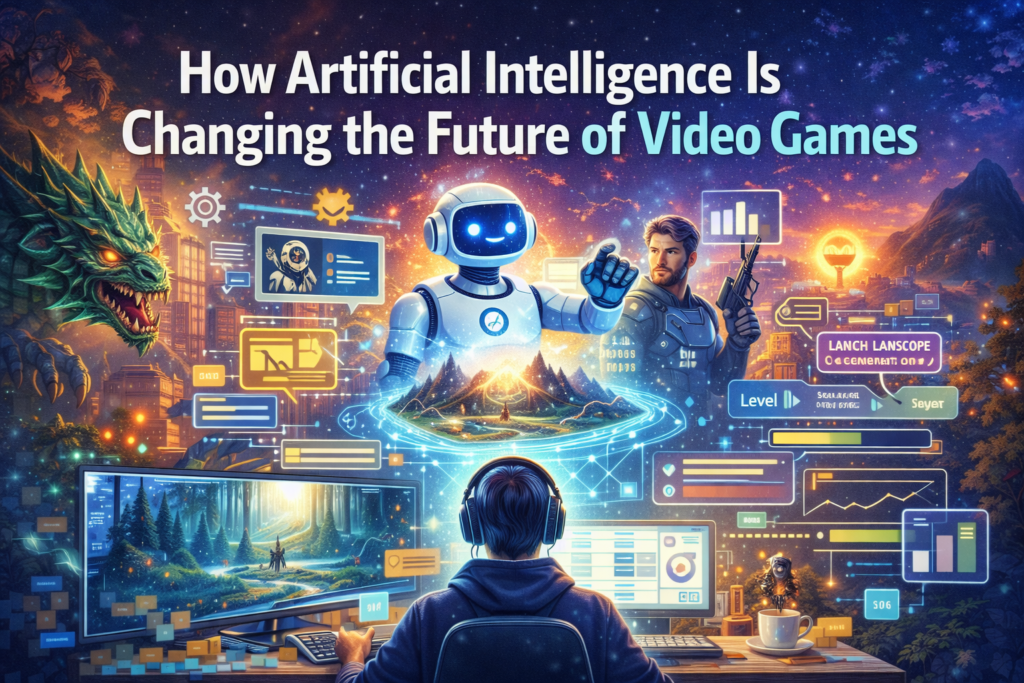
Artificial intelligence is beginning to change this process. AI-powered tools are allowing developers to generate large parts of game worlds automatically, dramatically expanding what is possible in open-world gaming.
Instead of designing every detail manually, developers can guide AI systems to create dynamic environments, characters, and experiences that evolve during gameplay.
Procedural Generation Meets AI
Procedural generation has existed in gaming for many years.
Some games use algorithms to generate landscapes, dungeons, or loot systems automatically. However, traditional procedural generation relies on predefined rules and patterns, which can sometimes lead to repetitive environments.
Modern AI systems introduce a new level of complexity.
Instead of following simple rules, AI can analyze design patterns and generate environments that feel more organic and varied. Landscapes, cities, and structures can be created with greater diversity, making exploration feel more natural.
This allows developers to build worlds that are far larger and more detailed than what would be possible through manual design alone.
Infinite Exploration Possibilities
One of the most exciting possibilities of AI-generated worlds is the idea of near-infinite exploration.
Imagine a game where new regions, cities, and missions are continuously generated based on player behavior.
Instead of exploring a fixed map, players could experience a world that expands dynamically over time. AI systems could generate new areas, creatures, or events that respond to how players interact with the game.
This type of dynamic world could dramatically increase replay value and player engagement.
Each player might experience a slightly different version of the same game universe.
AI-Driven Quest Generation
Creating quests and missions is another area where AI can help developers.
Traditionally, quests are designed manually by writers and designers. While this allows for detailed storytelling, it limits the total number of quests that can be included in a game.
AI systems can assist by generating side missions, objectives, and events dynamically.
For example, AI might generate quests based on:
- player location
- past decisions in the storyline
- character abilities
- events happening within the game world
These systems can help ensure that the game world always feels active and responsive.
Instead of repeating identical tasks, players might encounter missions that feel tailored to their journey.
Dynamic NPC Behavior
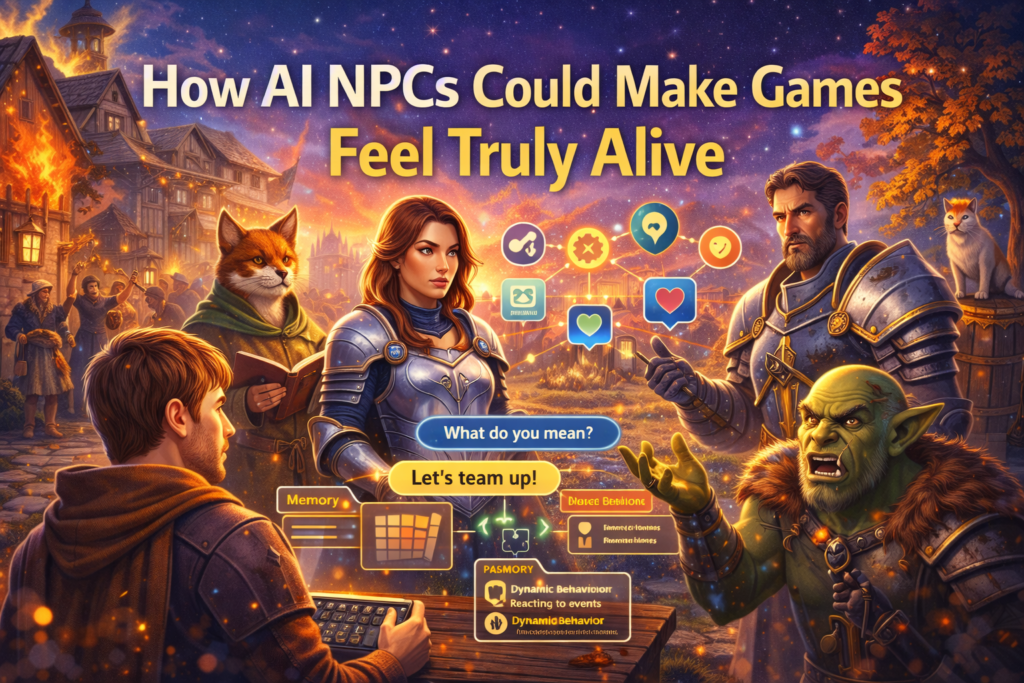
AI-generated worlds become even more powerful when combined with advanced NPC behavior.
In traditional games, NPCs often follow scripted routines. They may patrol certain areas or repeat the same dialogue regardless of what the player does.
AI-driven characters can behave more dynamically.
NPCs might react to changes in the game world, remember interactions with players, or develop relationships with other characters.
This creates the impression of a living world rather than a collection of scripted events.
Faster Game Development
Developing modern video games requires enormous resources.
Large studios sometimes spend five to seven years creating a single major title. AI tools can help reduce this development time by assisting with world building, asset generation, and environmental design.
For example, AI can generate:
- terrain variations
- building layouts
- vegetation and natural environments
- background characters
Developers still guide the creative direction, but AI can automate many of the repetitive aspects of world creation.
This allows studios to focus more on storytelling, gameplay mechanics, and artistic design.
Personalized Player Experiences
Another potential advantage of AI-generated worlds is personalization.
AI systems could analyze how players explore environments and adapt the world accordingly.
For example, if a player prefers combat challenges, the game might generate more battle-oriented encounters. If another player enjoys exploration and puzzle-solving, the AI might generate more hidden areas or mysteries to uncover.
This adaptability could make games feel more immersive and tailored to individual preferences.
Challenges of AI-Generated Content
Despite its potential, AI-generated game design also introduces challenges.
Developers must ensure that generated environments remain coherent and balanced. Poorly generated content could break immersion or create gameplay problems.
Another challenge is maintaining creative direction.
While AI can generate ideas and structures, human designers are still essential for shaping the artistic vision and narrative consistency of a game.
Balancing automation with human creativity will remain an important part of future game development.
The Future of Living Game Worlds
Artificial intelligence is pushing gaming toward a future where worlds feel more dynamic and alive than ever before.
Instead of static environments, players may soon explore evolving worlds that adapt to their actions and decisions.
AI-generated environments, quests, and characters could dramatically expand what is possible in open-world gaming.
For developers, this technology offers powerful tools to build larger and more immersive experiences. For players, it promises worlds that feel less like designed spaces and more like living ecosystems.
As artificial intelligence continues improving, the boundary between handcrafted game design and dynamically generated experiences may gradually disappear—opening the door to entirely new forms of interactive entertainment.